
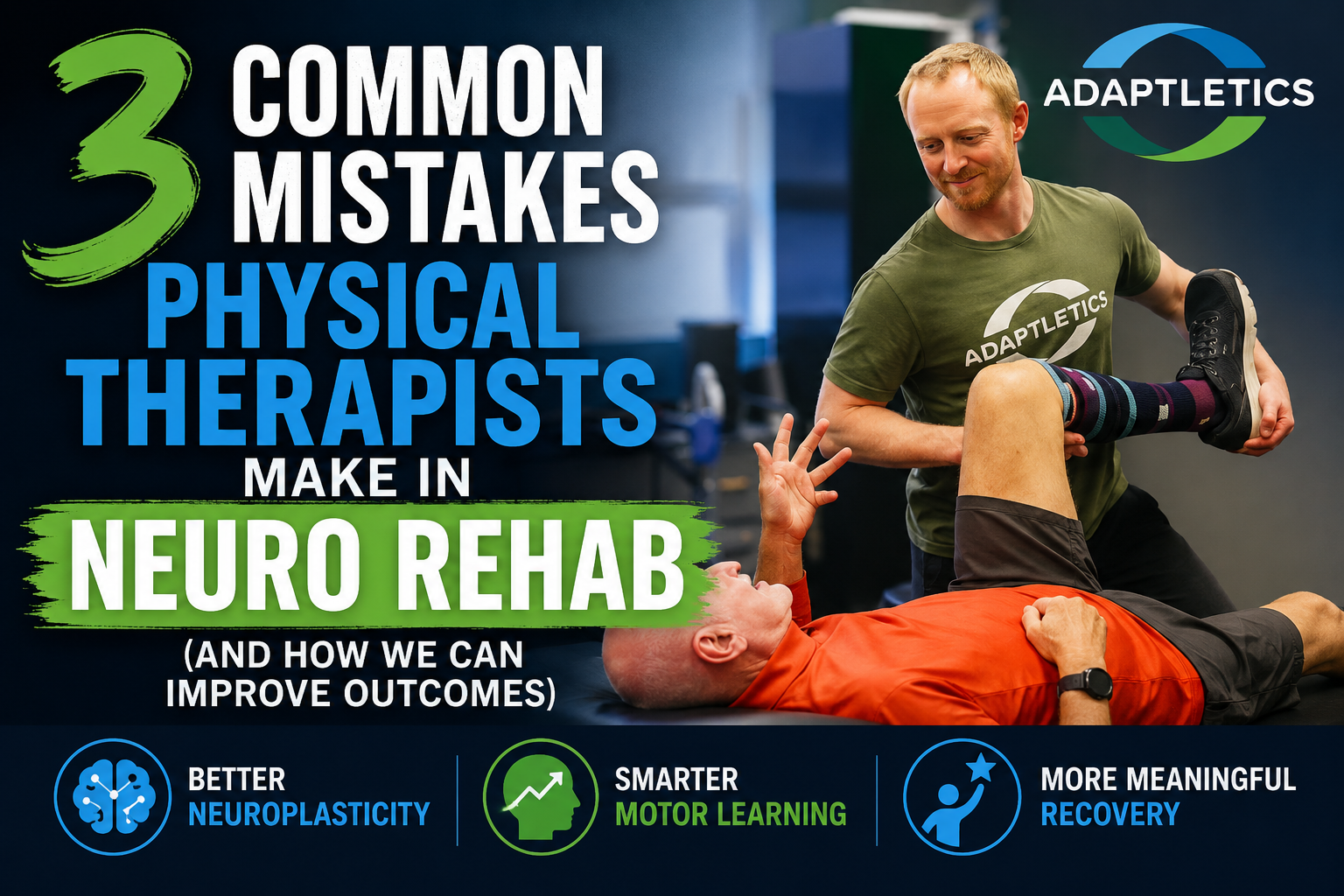
Improving Neuroplasticity, Motor Learning, and Patient-Centered Recovery in Neurologic Physical Therapy
Neurorehabilitation is one of the most challenging, rewarding, specialties in physical therapy. Every patient presents with a unique nervous system, unique impairments, and unique goals for recovery. Because neurologic rehabilitation is so complex, even experienced clinicians can develop habits that unintentionally limit patient progress.
This conversation is not about blame. It is about growth!
As research on neuroplasticity, motor learning, and neurologic recovery continues to evolve, physical therapists have an incredible opportunity to refine how we approach treatment. Small changes in exercise dosing, patient assistance, and goal selection can significantly improve outcomes for individuals recovering from stroke, traumatic brain injury, spinal cord injury, Parkinson’s disease, multiple sclerosis, and other neurologic conditions.
Below are three of the most common mistakes PTs make in neuro rehab, and evidence-based strategies to improve patient recovery.
1. Underdosing Exercise Intensity in Neuro Rehab
One of the biggest opportunities in neurologic physical therapy is improving exercise dosing, especially aerobic intensity (Mark G Bowden et al. 2020).
Many physical therapists unintentionally underdose neurologic patients due to concerns about safety, fatigue, or movement quality. While these concerns are understandable, emerging evidence suggests that neurologic recovery often requires greater physiologic challenge than we traditionally provide.
Why Exercise Intensity Matters for Neuroplasticity
Research shows that elevated aerobic intensity can stimulate the release of Brain-Derived Neurotrophic Factor (BDNF), a protein strongly associated with neuroplasticity, motor learning, and neural recovery (George Hornby, et al 2020).
BDNF supports:
Synaptic plasticity
Neuron survival
Motor learning
Cortical reorganization
Functional recovery after neurologic injury
Studies have demonstrated that higher-intensity aerobic exercise leads to greater increases in circulating BDNF levels compared to lower-intensity exercise.
Research Supporting Higher Intensity Neuro Rehab
A scientific statement published by the American Heart Association highlighted the relationship between aerobic exercise, neuroplasticity, and BDNF following stroke recovery.
Research in stroke populations found that vigorous aerobic exercise produced a significantly larger BDNF response than moderate-intensity activity.
Systematic reviews have confirmed that endurance-based exercise interventions may improve BDNF concentrations and support neurorecovery in post-stroke individuals.
What This Means Clinically
If a neurologic patient is medically appropriate for higher intensity training, we should consider intentionally elevating heart rate during therapy sessions.
This may include:
Aerobic interval training
High-intensity gait training
Circuit-based mobility training
Repetitive functional task training performed at higher intensity
Heart rate monitoring during treatment
The goal is not to push patients recklessly. The goal is to challenge the nervous system enough to stimulate adaptation.
Key Takeaway
Neuroplasticity thrives on challenge. If the nervous system is never stressed appropriately, the opportunity for recovery may be limited.
2. Providing Too Much Assistance Too Quickly
Physical therapists naturally want patients to succeed. However, in neurologic rehabilitation, helping too much can sometimes interfere with motor learning.
A line an old PT professor once told me was “concurrent feedback does not promote motor learning.” In physical therapy, concurrent feedback refers to information about performance provided during the execution of a movement. This can include verbal instructions or manual guidance from the therapist while the patient is actively moving. Concurrent feedback, as you will read, can inhibit learning via dependency, lack of error detection, and attention splitting (Ryohei Yamamoto 2014).
Patients with neurologic impairments frequently experience:
Motor planning deficits
Delayed movement initiation
Impaired sequencing
Reduced processing speed
Difficulty generating movement strategies
Because of this, patients often require additional time to problem-solve movement tasks independently.
Why Timing Matters in Motor Learning
Consider a patient attempting a sit-to-stand transfer after a stroke. A therapist may instinctively provide assistance the moment the patient struggles. But that pause, the few extra seconds spent attempting to organize the movement, may actually be critical for neural recovery.
Motor learning research consistently shows that the brain learns through trial, error, and feedback.
Without opportunities to make mistakes, the nervous system receives less information for adaptation.
The Role of Error-Based Learning in Neuro Rehab
Error augmentation and error-based learning have become increasingly recognized in neurologic rehabilitation literature.
Research demonstrates that:
Movement errors help refine motor strategies
Error-based learning enhances neural adaptation
Different error-based training strategies activate motor learning pathways in the brain
In other words, patients often need opportunities to struggle safely in order to improve.
Clinical Strategies to Reduce Over-Assistance
Instead of immediately correcting movement, clinicians can:
Allow additional processing time
Delay physical assistance briefly
Use verbal cueing before manual assistance
Provide graded guidance instead of full correction
Encourage exploration of movement strategies
Allow safe movement variability
Or get the patient in a safe environment to allow for mistakes without injury like an overhead lift system
Of course, safety always remains the priority. But there is a difference between guarding for safety and eliminating the patient’s opportunity to learn.
Key Takeaway
Recovery does not require perfect movement. Recovery requires the nervous system to actively problem-solve.
3. Focusing Too Much on Generic Functional Tasks Instead of Meaningful Goals
Neurologic physical therapy often prioritizes foundational tasks such as:
Bed mobility
Transfers
Standing tolerance
These interventions are important. However, they are not always meaningful to the patient. And salience matters!
What Is Salience in Neuroplasticity?
Salience refers to how meaningful, emotionally relevant, or personally important an activity is to the individual performing it. One of the core principles of neuroplasticity is that the nervous system changes more effectively when learning experiences are meaningful and engaging. When a patient deeply cares about a task, motivation and attention increase, and the brain becomes more invested in the learning process.
Examples of Salient Patient Goals
Patients may care less about:
Walking 200 feet in therapy
Standing for 10 minutes
Completing repetitive generic exercises
And care far more about:
Getting on the floor to play with grandchildren
Returning to painting
Gardening independently
Cooking family meals
Dancing at a wedding
Fishing again
Returning to church activities
These goals are not secondary to rehabilitation. They are often the true reason patients are fighting to recover.
Why Salient Interventions Improve Outcomes
Research on neuroplasticity suggests that meaningful, goal-directed activities:
Improve engagement
Increase repetition and practice
Enhance motor learning
Strengthen neural pathways
Improve carryover outside therapy sessions
As clinicians, this is where creativity becomes one of our greatest strengths.
How PTs Can Create More Meaningful Neuro Rehab
Therapists can:
Build interventions around hobbies and life roles
Simulate meaningful environments
Integrate patient interests into exercises
Combine restorative and compensatory strategies
Collaborate closely with patients on goal setting
A floor transfer becomes more meaningful when the goal is playing with a grandchild. Balance training becomes more engaging when it supports gardening or cooking.
Key Takeaway
Salience is not a bonus feature of neuro rehab, it is one of the driving forces behind neuroplastic recovery.
Final Thoughts: Neuro Rehab Is About Intentional Progress
Neurologic rehabilitation is incredibly complex, and no clinician gets everything perfect. But as our understanding of neuroplasticity and motor learning evolves, we have an opportunity to improve outcomes by refining how we approach treatment.
Three major opportunities for growth include:
Challenging patients with appropriate exercise intensity
Allowing more space for motor learning and error-based recovery
Designing interventions around meaningful, salient goals
These are not criticisms of clinicians. They are opportunities to elevate care.
Physical therapists already do extraordinary work in neuro rehab. By becoming more intentional with dosing, assistance, and salience, we can help patients unlock even greater recovery potential.
Because in neurologic rehabilitation, small changes in approach can create life-changing outcomes.
References
Bowden MG, Monsch ED, Middleton A, Daughtry C, Powell T, Kraft SV. Lessons Learned: The Difficulties of Incorporating Intensity Principles Into Inpatient Stroke Rehabilitation. Arch Rehabil Res Clin Transl. 2020 Apr 13;2(2):100052. doi: 10.1016/j.arrct.2020.100052. PMID: 33543079; PMCID: PMC7853341.
Hornby TG, Reisman DS, Ward IG, Scheets PL, Miller A, Haddad D, Fox EJ, Fritz NE, Hawkins K, Henderson CE, Hendron KL, Holleran CL, Lynskey JE, Walter A; and the Locomotor CPG Appraisal Team. Clinical Practice Guideline to Improve Locomotor Function Following Chronic Stroke, Incomplete Spinal Cord Injury, and Brain Injury. J Neurol Phys Ther. 2020 Jan;44(1):49-100. doi: 10.1097/NPT.0000000000000303. PMID: 31834165.
American Heart Association. Exercise Intensity and Neuroplasticity Following Stroke Recovery.
Boyne P, et al. Vigorous Exercise and BDNF Response in Stroke Rehabilitation. Archives of Physical Medicine and Rehabilitation.
Yamamoto R, Ohashi Y. The effects of inaccessible visual feedback used concurrently or terminally. J Phys Ther Sci. 2014 May;26(5):731-5. doi: 10.1589/jpts.26.731. Epub 2014 May 29. PMID: 24926140; PMCID: PMC4047240.
Frontiers in Neuroscience. Error-Based Motor Learning and Brain Activation.
Kleim JA, Jones TA. Principles of experience-dependent neural plasticity: implications for rehabilitation after brain damage. J Speech Lang Hear Res. 2008 Feb;51(1):S225-39. doi: 10.1044/1092-4388(2008/018). PMID: 18230848.
